Garment Engineering
Pattern Grading for Oversized & Baggy Clothing: What Brands Need to Know
An oversized tee or a baggy hoodie can look settled in the sample size and still change character once the rest of the size run is cut. The extra room is part of the design. It still has to stay in the same relationship from the smallest size to the largest.
Add the same amount to chest, shoulder drop, sleeve and body length, and a larger size can read as a different garment. Take the same amount off every point, and a smaller size can turn short, narrow, or lose the relaxed shape the sample was built around.
Pattern grading is the set of rules that moves each point of the pattern by its own amount. Fit, proportion and the balance of the style stay recognizable across the range. That work happens before bulk, while a change is still a pattern revision.
Brands developing relaxed T-shirts, boxy hoodies, baggy sweatpants and other streetwear silhouettes need those rules written down before the cloth is cut in quantity. At Jhwear, grading sits with sample development in Dongguan.
What Is Pattern Grading?
Pattern grading builds the other sizes from one approved pattern. The approved sample size is the base. From that base, each measurement moves by a grade rule agreed for that style.
Points that usually carry their own increment include:
- Chest or body width
- Shoulder width
- Body length
- Sleeve length
- Armhole
- Neck opening
- Waist
- Hip
- Rise
- Inseam
- Leg opening
Those points rarely share one number. Chest might grow more than body length. Hip might grow more than the leg opening. The increments exist to keep the fit the sample already proved.
Grading Is Different From Scaling
A pattern is a set of related pieces, so it behaves differently from a picture you enlarge. If every line grows by the same percentage, the shoulder, the sleeve and the hem stop matching the shape you approved.
A boxy tee moving from M to L may need a clear step in chest width, and a much smaller step in shoulder and body length. A baggy sweatpant may need more room through the hip and thigh, while the leg opening stays closer to the base size.
Grading applies those separate steps. Each area changes by the amount that style needs.
Scaling
Uniform enlargement:
- Every dimension changes together
- Proportions can drift
- A poor method for a production size run
- Oversized features get exaggerated
Pattern Grading
Controlled size development:
- Each measurement has its own increment
- The fit relationship can stay intact
- How the garment is worn is part of the rule
- This is how a production size range is built
Key takeaway
Grade each area for the fit it has to hold. Enlarging the whole pattern as one shape will not keep an oversized silhouette honest.
Why Oversized Clothing Needs Different Grading Logic
Oversized clothing is built on extra volume that was chosen on purpose. That volume still has a limit in every size. The larger size should keep the same idea of width, length, shoulder position, sleeve volume and overall shape.
When those relationships slip, the extra room shows up in the wrong place. The garment gets bigger, and the design gets lost.
Width and Length Should Not Increase at the Same Rate
A frequent miss on oversized styles is letting length grow as fast as width. A boxy tee often wants a clear chest step between sizes and only a small step in body length. If the hem drops too fast, the larger sizes lose the cropped or controlled proportion the sample had.
Hoodies and sweatshirts follow the same logic. The body and the sleeve may need more room, while the total length stays close to the base. Width and length are separate decisions.
Drop Shoulder Needs Controlled Grading
A drop shoulder already sits past the natural shoulder point. Grade that width too hard and the larger sizes get extremely wide, with the sleeve starting too far down the arm. Grade it too little and the oversized shoulder disappears as the chest grows.
Review these together:
- Shoulder width
- Sleeve length
- Armhole depth
- Chest width
- Sleeve opening
Sleeve Proportion Can Change the Entire Silhouette
On a boxy hoodie or tee, the sleeve often carries as much of the look as the body. If sleeve length grows too fast, larger sizes look unfinished. If sleeve width barely moves, the body stays oversized and the sleeve looks tight beside it.
Sleeve grade, shoulder grade and body grade belong in one review.
Standard Fit Grading
A closer fit usually works from:
- Width and length that step together
- A tighter link to body measurements
- Increments that repeat in a familiar way
- Little extra movement at the shoulder
Oversized Fit Grading
A relaxed or baggy fit usually needs:
- Length that grows more slowly than width
- A careful shoulder increment
- Sleeve volume that stays in step with the body
- The boxy or relaxed shape kept on purpose
Key takeaway
Oversized grading protects the silhouette. Making every measurement larger is a different job.
Common Grading Problems in Oversized & Baggy Fits
A correct base sample can still produce a weak size run. The usual cause is a grade that is too steep, too even, or borrowed from a closer-fitting style.
Too Long
The garment grows longer with every size up. Typical causes:
- Body length graded too steeply
- A standard-fit grade used on a boxy shape
- Width and length stepped by similar amounts
- A cropped or controlled hem left out of the rule
This shows quickly on oversized tees and hoodies that depend on a wide body and a held length.
Too Wide
The garment gets broad enough to lose its balance. Typical causes:
- Chest width stepped too fast
- Shoulder width graded too hard
- Sleeve volume added on its own
- Hip or thigh opened too far on baggy bottoms
An oversized piece should still look chosen. Extra room everywhere is a different result.
Lost Proportion
Separate parts of the garment stop belonging together. Examples:
- Sleeves that look narrow against the body
- Shoulders that run too far past the arm
- Body length that outgrows the width
- Leg openings that open too far
- Rise or inseam that no longer matches the silhouette
Read the grade on the whole garment. A correct chest number can still sit inside a shape that no longer matches the sample.
Key takeaway
A grading problem is usually a proportion problem. The measurement chart can pass while the garment looks wrong.
How Fabric Weight and Structure Affect Grading
The grade and the cloth belong in the same review. One pattern can look unlike itself in a light jersey, a compact heavyweight cotton, French terry or a brushed fleece.
Weight, stretch, drape and structure change how the graded garment sits on the body. On oversized and baggy styles, the look often depends on the cloth holding a specific shape.
Heavier Fabrics Can Make the Same Pattern Look Larger
A dense or heavy cloth adds body. The same measurements can look wider and more substantial once the fabric has more structure.
A useful comparison:
- A cotton jersey around 260 GSM can make a softer oversized tee
- A compact jersey around 320 GSM can hold a boxier shape
- A fleece around 400–450 GSM can add volume to an oversized hoodie
Copying a grade from another style, without the cloth that style used, is a common way to miss the silhouette. Review the rule with the fabric you intend to cut.
Stretch Can Change Fit Across Sizes
Stretch and recovery change how much ease the pattern needs. A cloth with real recovery can sit differently from a rigid or low-stretch cloth at the same flat measurement.
Pay extra attention on:
- Ribbed cuffs and hems
- Stretch waistbands
- Fitted panels
- Joggers with elastane
- Streetwear that borrows activewear cloth
The more the fabric stretches, the more the size run should be checked under tension, not only on the table.
Drape Affects the Visual Result
Two cloths at the same GSM can still hang differently. A softer cloth with more drape falls closer to the body. A denser cloth stands away and can make the oversized effect stronger.
When the fabric changes in a meaningful way, check the grade on a new sample. A flat measurement from the previous cloth is a weak guide.
Size Set Samples and Fit Verification
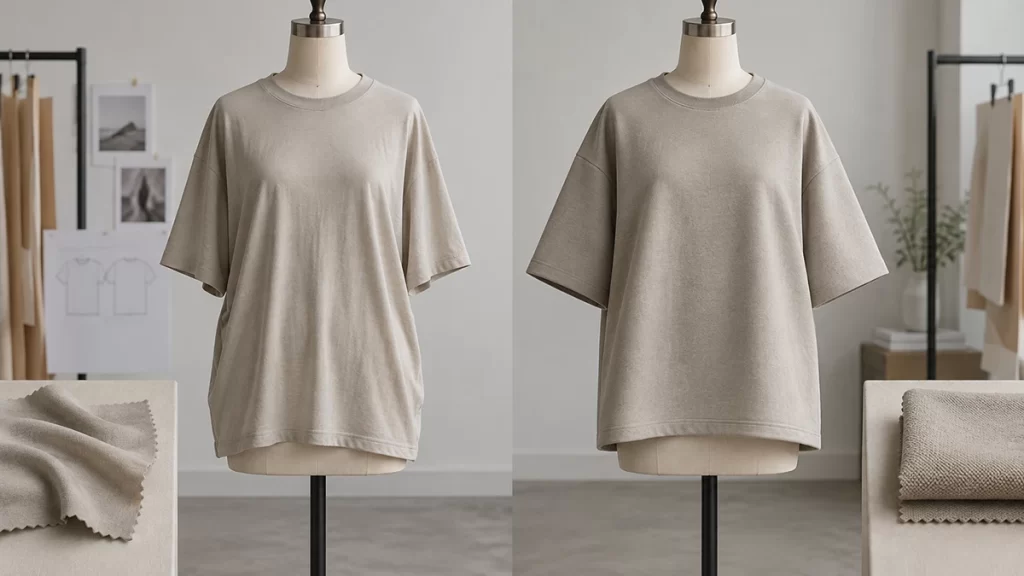
Approval of the base size does not automatically approve the rest of the run. On oversized and baggy garments, a small grade error becomes easier to see as the sizes spread out.
A size set lets the brand and the factory look at the silhouette in more than one size before bulk cutting starts.
Why Size Set Samples Matter
A size set can show:
- Larger sizes growing too long
- Shoulder drop becoming too deep
- Sleeves turning too wide for the body
- Smaller sizes losing the oversized effect
- Hip or thigh volume changing too fast
- Leg openings turning too narrow or too wide
- Rise and inseam falling out of balance
None of those have to be obvious on the base sample alone.
Check Proportion, Not Just Measurements
A graded piece can hit the measurement chart and still look off. Chest width can be correct while the shoulder, sleeve and body length no longer make the boxy shape you approved.
A size-set review covers both:
- Measurement check against the grade
- A visual check of fit and proportion
On oversized clothing, the relationship between areas often matters more than any single number.
Which Sizes Should Be Checked?
Every size does not have to be sewn before production. It is useful to see how the grade behaves across the range.
For a run from XS to XXL, a practical check is:
- The base size
- One size below the base
- One size above the base
- The largest size, when the proportions shift the most there
That spread shows whether the rule still holds at both ends.
What Brands Should Approve Before Bulk Production
Before bulk starts, both the graded spec and the physical garment should be approved. On oversized and baggy styles, a small proportion error is much louder once the full size run is on the line.
A useful sign-off covers two lists.
Specification Approval
Confirm the graded specifications:
- Final measurement chart
- Grade rules
- Size range
- Shoulder increments
- Body width increments
- Body length increments
- Sleeve grading
- Hip and thigh grading
- Rise and inseam grading
- Leg opening measurements
Garment Approval
Confirm the physical result:
- Base size fit
- Size set proportions
- Oversized silhouette
- Shoulder position
- Sleeve balance
- Body length
- Fabric behavior
- Movement and comfort
- Visual consistency across the sizes you checked
- Which sample is the approved one
Key takeaway
Approve the measurement grade and the visual proportion before bulk. A chart on its own leaves the silhouette unchecked. The graded garment should be looked at, so the design still reads the same way across the range.
Keep the Final Grade Rules Documented
Once the size set is approved, write the final grade rules down and use that file as the production reference. That keeps an older pattern or an outdated chart off the cutting table.
If the fabric, the fit or the construction changes in a real way after that approval, review the size range again before bulk.
Final Thoughts
Grading oversized and baggy clothing is the work of keeping the original design across the size range. Each size still has to fit and move. The silhouette should stay the one you approved on the sample.
For these garments, control the relationship between:
- Body width
- Body length
- Shoulder width
- Sleeve volume
- Rise and inseam
- Leg opening
- How the fabric behaves
A reliable path is to approve the base sample first, review the grade rules, check selected size-set samples, and confirm both the numbers and the look before production. That is how a style that looks balanced in one size stays balanced when the full run is cut.
Need Help Developing Oversized or Baggy Fits?
Jhwear develops oversized tees, hoodies, baggy sweats and other private-label styles in Dongguan, including pattern work, grading, sample fitting, fabric and bulk. Send the product type, the size range, fabric notes and a reference for the silhouette.
Sampling usually takes about 7 working days after those details are confirmed. Bulk production is usually 25–35 working days after sample approval. Cut-and-sew MOQ starts at 50 pieces per design. Seamless MOQ is 500 pieces per style, per color, per size.
Reach the team through the contact page, WhatsApp +86 13332693486, or w1437s@gmail.com.
Common Questions
Pattern grading builds the other sizes from one approved base pattern. Each measurement uses its own increment so the fit and the proportions stay consistent across the size range.
Yes. Oversized styles usually need slower growth in body length, a controlled shoulder step, and sleeve volume that stays in step with the body. A standard-fit grade can make larger sizes too long or too wide.
A size set is the practical way to see the grade in more than one size. It shows proportion issues that the base sample alone will not reveal. You can check the base, one size down, one size up, and the largest size when that end of the run shifts the most.
Only when the cloth behaves the same way. Weight, stretch, drape and structure change how a graded pattern looks and fits. If the fabric changes, review the size range on a new sample.
Confirm the measurement chart, the grade rules, the size range, the fabric, the base fit, the size-set samples you chose to check, and the visual proportions. At Jhwear, bulk usually starts after that sample approval and runs about 25–35 working days.
Scaling enlarges or reduces every dimension by the same rate. Pattern grading changes each part of the garment by the amount that fit and the design require. That difference matters most on oversized and baggy shapes.